
Stravinsky, The Rite of Spring, Rehearsal Numbers 7-8
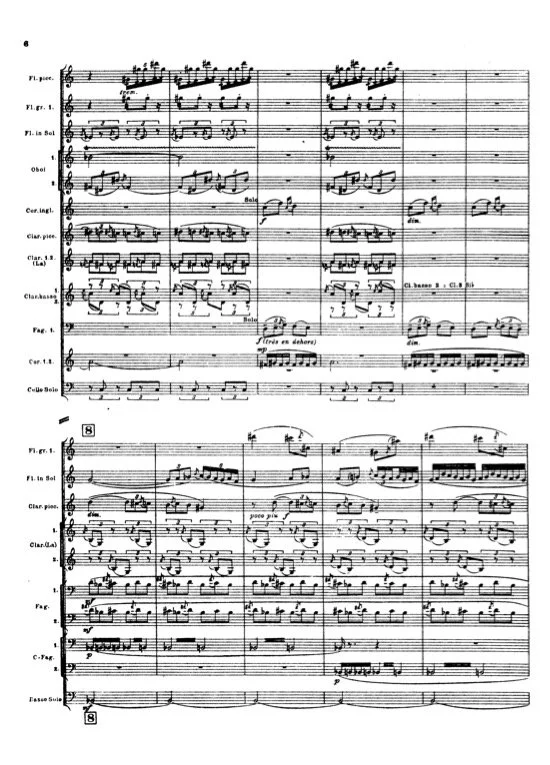
Melodic layers and orchestral texture
The passage is highly polyphonic. It’s gorgeous.
Rehearsal letter 7:
English Horn echoes the main melody first stated in beginning of the entire ballet.
Clarinet in D: short downward-sloping four-note bursts in a pleasant register. Sounds sad and scary when melodies go downward like this, kindof like they are spinning downwards. Maybe that melody listened to too much Nine Inch Nails. Bah dum!
Rehearsal letter 8:
Multiple simultaneous melodies; flute takes a bright, strongly linear, acrobatic melody that jumps octaves.
Alto flute functions as texture but remains clearly melodic. It’s felt more than projected.
Clarinet piccolo in D doubles a similar line to rehersal 7, but stands out due to relative intensity vs. the flute.
Observations on doubling and clarity:
When two instruments are doing interesting melodic work at the same time (e.g., flute and clarinet piccolo in #8), contrasting registral placement and differing melodic structure (linear vs. closed and bursty fragment) help them be heard distinctly; putting the lines in very different registers increases perceptual separation.
Rhythm and articulation
Stravinsky achieves a highly unsettling rhythmic effect with relatively little material between rehearsal letters 7–8.
Cello solo: plays Pizzicato on the offbeat, creating displacement against the pulse.
Bass clarinet: strongly linear rhythmic ostinato with frequent grace notes.
Clarinets (two in A): rich territory, doubled writing with many grace notes.
In rehearsal letter 8 the bassoons take over the rhythm role in roughly the same manner as the clarinet and bass clarinet had in rehersal number 7.
Also at rehersal 8 the clarinet in A shifts from unison doubling toward more blend of differentiated motion. This is a nice trick I’m going to remember.
Sustained sonorities and harmonic color
Rehearsal letter 7:
Alto flute provides a warm sustained color on strong beats.
French horn sustains a concert D5, contributing a warm “golden” territory.
“Elbow” (likely an instrument/line labeled in the score) trails as a sustaining motion in the same warm register.
Rehearsal letter 8:
Contrabass soloist sustains a mellow B♭2 as an anchoring sound.