
Stravinsky, The Rite of Spring, Compositional Overview, Live Blogging Experiment
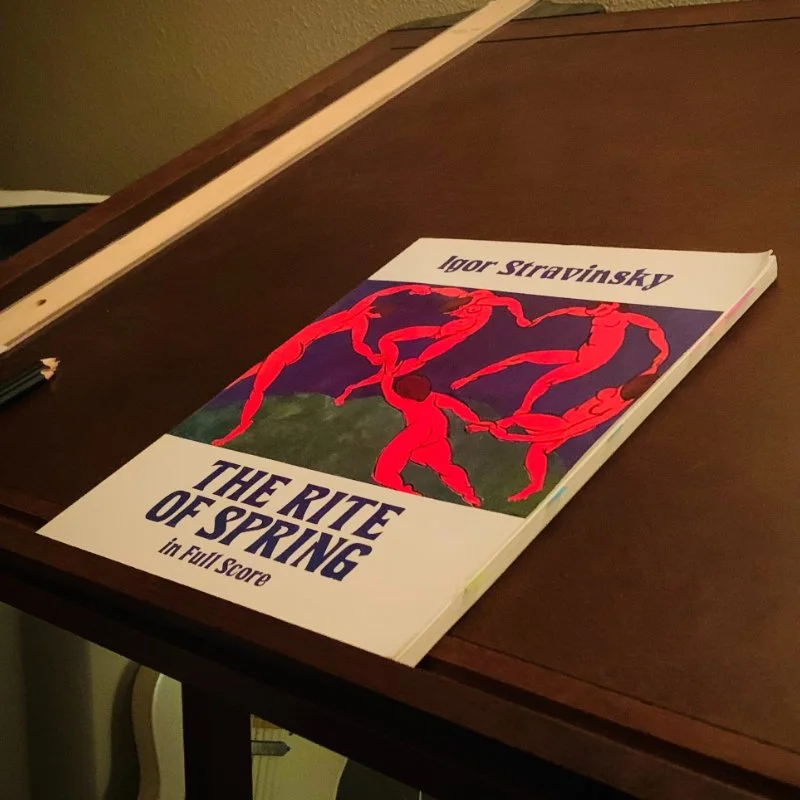
Just about every serious composer looks with awe and drea at The Rite of Spring, and I include myself in this category. My teacher in college, the wonderful Carol Hess, introduced The Rite of Spring to us hapless, hopeful undergrads. I was mystified by it’s power, uncompromising intensity, and set an intention to study it more seriously… one day.
Compositional Outlook of The Rite of Spring
What follows is a brief overview of the compositional outlook by Stravinsky in The Rite of Spring.
Stravinsky tended to melodically and harmonically structure the Rite in three ways:
Shorter, more lyrical melodies in general (3-4 note patterns) with heavy rhythmic and melodic variation.
Employing boistrous, explosive, and rhythmic designs for the orchestra, at times overwhelming the listener with the depth of power.
Getting dark with his harmonic vocabulary towards the latter half of the Rite.
Stravinsky loved changing time signatures. Any casual glance at the score will show how he loved shaking the meter of the music all up. He pretty much liberated himself from the historical constraints of rhythm.
Polyphony. He used the hell out of it.
Polytonality. He often wrote melodies in one key, harmonies/rhythmic accompaniments in another. Yet, there was always a sort of consistency. It sounded dissonant sometimes. Altogether, the dissonance is quite pleasing.
Melodies established in earliest parts of the Rite have a tendency to resurface, thus creating a melodic through-line that binds parts together. I love doing this in my film scores, and it was a joy to see that Stravinsky hadn’t completely abandoned this practice.
As far as orchestrations go, Stravinsky loved really weird instruments in the woodwinds. He would often change the timbre of each section, but by focusing on the woodwinds.
There’s a school of thought that asserts that woodwinds can be broken down into two basic groups: Soft woodwinds (flute and clarinet) and harsh woodwinds (oboe and bassoon).
Stravinsky made full use of the auxillery woodwinds and changed up the sound from one part to the next.
Compositional Live-Blog
I don’t know exactly whether or not I will keep doing this, but I have a mind to share my own thoughts as I work my way through the Rie of Spring. I tend to go section by section, until I finish my analysis.
I won’t commit to finishing this publically, but who knows. I might just do that. I’ll start here.