43_JRR_20240907_0032.jpg

Blog

Posts tagged Creativity
How To Catch The Really Big Ideas

Reading Notes

10-12 Minute Read | Laptop or Tablet Recommended

Topics and Themes

The big ideas; How to wait and invite the biggest ideas in; How social media keeps us from catching game-changing ideas.

Affiliate Note

When you make a purchase through links found on this site, we may earn commissions from Amazon, Perfect Circuit, and other retailers.

Like so many others, I watched The Odyssey in IMAX. After the film was finished, I was purblind to gauging my emotional response. I know the reason why, and I really can't put it any other way: The Odyssey somehow reminded me of a feeling I had never felt before. The film stirred emotions on such a deep level that I had trouble expatiating how I felt. The film felt extremely personal, like meeting a person I've never talked to and yet we knew each other intimately. I wasn't the only one with a very unique reaction. Many of my colleagues in film were also blown away, each in their own way. It's safe to say that the film touched something deep in all of us.

That a filmmaker can create a film that resonates so deeply with so many people hits me with indescribable annoyance. I'll fully admit that I wish I could do that. Of course, I have to keep in mind that Christopher Nolan, the director of The Odyssey, commands large budgets, hires the best actors and collaborators, and has developed a pythonic support system over the course of a 25+ year career. But there’s something more to this movie than logistics... something buried under integuments of interpretation.

How on earth did he come to the idea of doing a modern interpretation of The Odyssey in the first place? What does Christopher Nolan do that allows him to think that deeply?

The best theory I've got came after I ruminated on what Matthew Crawford meant by "dumb nature" in the context of modern psychological behavioral adaptations in his book The World Beyond Your Head:

“…When dumb nature is understood to be threatening to our freedom as rational beings, it becomes attractive to construct a virtual reality that will be less so, a benignly nice Mickey Mouse Clubhouse where there is no conflict between self and world.” (Crawford, 2015, p. 77)

We'll get into why I think this quote and concept are important, later. Before we do, a little context might be helpful.

First, know that The World Beyond Your Head expatiates on a theme of the philosophy of representations and symbols. Crawford points out that there's a great deal of weirdness in environments that use symbols to guide and focus our attention for us. He uses The Mickey Mouse Clubhouse as a prime example about how there's deliberately little to no cognitive dissonance in any of the programming, no confrontation with problems without an automatically prescribed solution, or a set of solutions presented as options. If only life were that simple! I'd love to have a set of solutions given to me for some of the problems I face!

Another example would be the ubiquitously creepy catch-all term "social media." At this point, can we really say it's more than a big ole' echo chamber of our favorite content that barely challenges us to think critically about the world around us? If you read Crawford's book, and I recommend it highly, the afflatus of replacing the rub and rash of reality has its origins in Emmanual Kant's writing and theories, but in the past 200+ years has morphed into a leviathan of social engineering that I suspect secretly wishes to separate our wills from reality. This scares the living shit out of me. Without a direct experience of reality as it is, how can we develop any sense of character, let alone a ideographic response to the world we live in?

If I am reading Matthew Crawford correctly, dumb nature could mean to be reality at it's most raw. Reality that is whatever speed it wishes to be... Maybe a lot of boredom punctuated by moments of high drama and excitement. The good, the bad, the ugly. Dumb nature, in short, encompasses everything deliberately not engineered for us, occuring and unfolding as it will. Contrast that with highly addictive symbols that are socially engineered, aka the posts we see on our Instagram feeds, providing a limitless supply of entertainment, stimulation, and bright and shiny objects. Dumb nature cannot hope to compete with the sheer amount of novelty that a curated, personally informed digital environment can deliver.

And yet, what are we to make of something as big and monumental as The Odyssey? I can't help poo-poo the social media feeds because it seems that the most lasting ideas were given to people who don't even bother with them, people who are a bit outside the mainstream. I'm going to bet that the directors that I most admire in this golden age of cinema are willing to tolerate dumb nature because they expect it to deliver something extraordinary to them. When it does, they are in the enviable position to capitalize on these ideas. What comes out of that are films like The Odyssey. Like Dune. Like Michael. Like Sinners. Like The Revenant. And, though it’s an oldie it’s a goodie, Pans Labyrinth.

In the hush of dumb nature, I believe the most epic ideas have more room to come to us and are more likely to be taken very seriously. I believe that when we have just the right balance between the the outside and inside worlds, when we disregard the noise loops and keep an Apollonian distance from the comings and goings of algorithms, we can logically expect the bigger ideas to come. I chuckled out loud when I saw an example of this in Antoine Fuqua's wonderful film Michael. When Michael Jackson's character, played by Jaafar Jackson, was floating in a pool and was gazing off into the distance, his brothers in the movie asked him what he was doing:

"I'm letting the Creator give me a song. If I’m not there to receive these ideas, God might give them to Prince."

To encourage those big ideas to come and to be ready to hold them, we have to be quiet enough to hear them in the first place. Hushing to that level requires silence and a still mind. This practice is highlighted again and again by many authors writing on the subject of creativity. It's highly recommended by the author Eric Maisel in the book Fearless Creating:

"Hushing is what we do when we go into a museum and sit in front of one painting for fifteen minutes. Hushing is what we do when we drink in a book or a movie. Hushing is what we do when we quiet our mind so as to catch the snatch of melody or lyric that is wanting to arrive. Hushing is quieting and opening... To create... you need a quiet mind so that ideas have a chance of connecting." (Maisel, 1995, p. 4)

To be quiet is to come into contact with dumb nature, and that also comes with a bit of adversity. It's not a bad idea to expect a little conflict. In the absense of novelty, the time is filled with the best kind of creative anxiety about what we plan upon creating and working on. It's like in the Allegory of the Cave: When taken out of the cave and pulled into the sunshine, it can be extremely painful and overwhelming at first, but indescribably beautiful after you get used to it. Fortunately, the literature on creativity also points towards the extreme goodness of embracing that confrontation. David Bayles and Ted Orland have a passage about it in their book Art and Fear:

"We're all subject to a familiar and universal progression of human troubles—troubles we routinely survive, but which are (oddly enough) routinely fatal to the artmaking process. To survive as an artist requires confronting these troubles. Basically, those who continue to make are those who learned how to continue—or more precisely, have learned not to quit." (Bayles and Orland, 2010, p. 9)

Confront we must, and though we put up a mad fuss when we're frustrated (or maybe I'm just speaking for myself) we don't quit when the going gets tough. I don’t like quitting. Quitting annoys me. I dare say that keeping at it makes me feel alive. And, in that confrontation with dumb nature, we're waiting for that big idea to hit us hard. It’s gonna come to us, we can feel it. That gargantuan idea will soon call us home.

The painter Jeane Carbonetti captured the sentiment of waiting and the conflict it creates in a beautiful way in her book Making Pearls:

"For the oyster making a pearl, waiting is characterized by two events: It recognizes instinctively that it is hungry; then it literally cements itself to a surface and waits. For the human pearl maker, waiting is when you hear the first stirrings of intuition that seem to beg for development—the tug of instinct that gnaws in the gut, a restlessness, perhaps an anxiety... this is the life force tapping you on the shoulder, asking to be engaged, whispering in your ears, 'It's time for this, now.'" (Carbonetti, 2001, p. 20)

To wait for such a moment requires a great intensity of purpose and a fuckload of faith. It requires a willingness to chill out and allow things to come together on their own accord, away from any sorts of unceasing demands of the outside world. Julia Cameron describes this intensity with her fabulously effective technique of reading deprivation in the classic book on creativity The Complete Artists Way. Reading deprivation is an exercise where she asks you not to read anything for a week (!):

"It is a paradox that by emptying our lives of distraction we are actually filling the well. Without distractions, we are once again thrust into the sensory world. With no newspaper to shield us, a train becomes a viewing gallery. With no novel to sink into, (and no television to numb us out) an evening becomes a vast savannah in which furniture—and other assumptions—gets rearranged... Reading deprivation cast us into our inner silence. …We often cannot hear out own inner voice, the voice of our artist's inspiration, above the static." (Cameron, 2007, p. 96)

Miracles happen in this space away from the distractions, but they are simultaneously rare and elephantine. Some would say that they happen when you’re ready for them. But when you do experience a creative miracle of that magnitude, it is an irresistible experience. You won't forget it anytime soon. The rarity guarantees appreciation. It’s like dreaming you are a virtuoso pianist, fingers flying all over the keyboard, and it sounds epic. The only difference is that the miracle is real. It happens in waking life!

The price for admission? We have to be cool with being quiet and ready for large creative miracles to come to us, and we must willingly and directly confront reality. If we're not present, if we're not calm and hushed, if we're not primed and ready for the conflict and the anxiety, forget about it. The most irresistible ideas will elude us.

I am becoming more and more convinced that our ability to invite and hold ideas on this level becomes just a little more endangered when we give ourselves up to doom-scrolling. I don't think it’s helpful to be so plugged in that we miss the larger, incredibly delectable, unbelievably irresistible ideas that are waiting beyond the periphery of our attention. To catch them, all we need is a tiny bit more space to receive them with the alacrity, care, and attention they require.

One day, maybe after a great deal of hush-time, a lot of exposure to dumb nature, that pantagruelian idea will show up. We have primed and prepared ourselves to receive it and be open to it, so it makes sense it should arrive. When it does it springs forth with great aplomb! BOOM! Big ideas are few, but with great anticipation and with an immense relief and satisfaction, they arrive.

To invite the big ideas that have kind of impact, I do believe we need to be willing to limit screen time to receive them. This is a great reason to give doom-scrolling a break, for putting your phone in a box, for trying to do something mad different. I think it's extremely healthy to confront dumb nature long enough to get in touch with the depths of our imaginations and commune with the game-changing ideas that make us feel alive.


Bibliography

Perfectionism is Boring As F**k

Reading Notes

1-3 Minute Read | Laptop or Tablet Recommended

Topics and Themes

Pareto's Principle and it's application in creativity; Overcoming perfectionism; Quantity vs. quality in sharing

Affiliate Note

When you make a purchase through links found on this site, we may earn commissions from Amazon, Perfect Circuit, and other retailers.

I let go of perfectionism long ago. It was easy. All I had to do was apply Pareto’s Principle to my creative output.

What is Pareto’s Principle?

Also known as the 80/20 rule, Pareto's Principle states that roughly 80% of effects come from 20% of causes. This means that a small number of inputs often lead to the majority of results.

Pareto’s Principle is most often applied in business, economics, and time management. Tim Ferriss popularized it in the Four-Hour Work Week.

I applied Pareto’s Principle to my creative output. It destroyed perfectionism, forever. Here’s how:

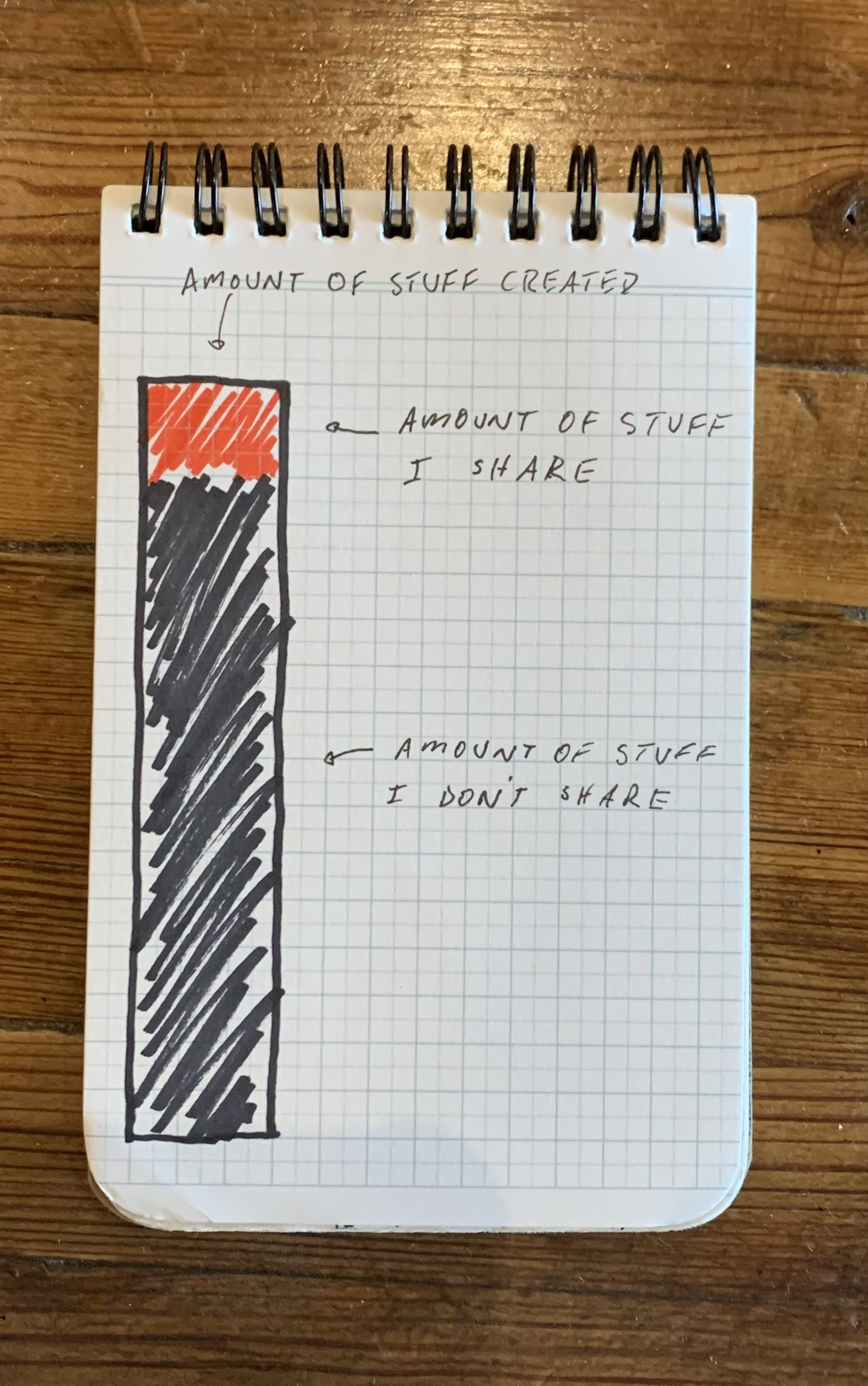
First, I increased the amount of stuff I created, aka the “inputs.” (in red and black). This includes blogs, writing, eurorack patches, orchestrations, musical sketches, and songs. I have no filter, here. I just create. Quantity over quality, as Julia Cameron states in the Artist’s Way.

Second I shared only a small amount of the “results” (in red, only). This consists of the music and blogs I release that are publicly available.

In other words, anywhere from 1% to 10% of what I create will actually get shared:

The more I write, compose, and create, the higher the number of things I will actually share.

Here’s a a cozy little one-liner that encapsulates my attitude:

The more I create, the more I’ll share.

Adapting Pareto’s Principle to your creative output can reshape your expectations in several interesting ways:

  1. You need not share everything, since most of it won’t be shareable. This encourages you to create prolifically, knowing that most of your work will remain private and in your grasp.

  2. Only the pieces that are worthy of polish, the ones that feel incredible and noteworthy, will actually get shared.

  3. Of the things you share, your audience can be as vast as the entire world or as small as a single close friend. You need not share them with everyone.

So, create prolifically, share your output wisely, and say goodbye to perfectionism forever. Because perfectionism is boring as fuck.

A Life of Fewer No's

Reading Notes

6-8 Minute Read | Laptop or Tablet Recommended

Topics and Themes

The evolution of the creative life, finding joy, transforming creative setbacks into guidance.

Affiliate Note

When you make a purchase through links found on this site, we may earn commissions from Amazon, Perfect Circuit, and other retailers.

A life of creativity is a life of fewer and fewer "no's." And, it all starts with a little bit of beginner's luck.

When first you answer the call to pursue a new creative path, for some reason you receive a burst of energy. The wind is at your back. Paintbrushes are on sale. A neighbor has a guitar gathering dust in their closet. Your Mom has a close friend who is a retired choreographer. It's almost like someone (Universe? Truth? God? Energy? Thin air? Who?) is telling you, "Yes... Do this!" I love this part. It's like getting a blast of luck to help you get on your way, a little extra verve in your step.

While it's nice to begin with such energy and excitement, sooner or later it leaves us. We shouldn’t be surprised to feel a little bit tired of engaging with this new creative pursuit. Perhaps we're feeling too tired to practice. The idea of picking up a paintbrush seems a little overwhelming. Stretching out on the mat to warm up just seems a little more brittle than usual. It's almost as if we're beginning to see the tiniest “no's” on the horizon.

This is okay. It's part of the process. The work almost always loses the beginning flow. After that initial burst of energy wears thin, sooner or later the hard work beckons us. At that point, we have decisions to make and trade offs to experience. It almost seems as if more and more reasons to stop appear to us, more and more “no's.”

Oh, those ugly no's.

If you've ever met someone who has trouble finishing, they probably quit at this point. I don't judge or blame them.

For those obstinate enough to keep moving forward, there's good news: The amount of “yes's” slowly increases. Perhaps it comes in the form of gaining comfort with a routine. With each blank canvas, your body begins to feel settled into a rhythm. With each tired morning getting up to make your coffee, you feel a little bit relieved you don't have to think about whether practicing is an option. With each extra hour on stage, it becomes more like home. Finishing a piece somehow gets just a little bit easier because of the routine you’ve built. The act of showing up has become more and more comfortable.

As the routine gets deeper, sooner or later some magic begins to pop-up. The writing of the novel comes unstuck and you're on a hot streak; 50 pages flow out of you. On the 200th time coming back to the Eurorack synth (I'm speaking for myself here), the sounds become incredibly detailed, nuanced, and deeply interesting. On the 10th night of a rock tour, the band finally finds it's rhythm and it begins to push deeper at the experience to see what else they can do.

At this stage, the creating goes so darned easily. Fewer no's. More yes's. At times, you might experience what it's like to sit back and marvel at the beast of a painting that's staring right back at you. It's a wonderful feeling to have invested your time into a chosen activity and finally have felt the epically smooth flow while engaged with it.

Sooner or later, the "no's" begin to shift in their character. Whereas before, a "no" felt like a great shutdown and perhaps a slap to the face, a "no" becomes more like guidance. It’s almost as if the “no” were saying, "Hey, if you want to keep on creating and feeling the awesomeness of creating, don't go to that place... Go here instead." They become directional markers, signs for where to go.

The no’s guide you into the flow, over and over again. The work keeps going. You don't stop. You're on a roll now. Work is easy. It's fun and enjoyable. Your creativity has become an integral part of your life, and all your friends know you as the creative one. You can speak easily and confidently of what you do. People will marvel at your ability to dance Argentine Tango, at your output as a prolific short story writer, as a ceramics artist of high yield. The amount of "no's" decreased while the amount of yes's become more populated throughout your body of work. More and more flow comes to you as you dig deeper into the craftsmanship of the work. Yes. Yes. Yes! Your pieces have a deeper, more mysterious quality to them, as if they couldn't possibly have been made by you.

After years of creation and a deep creative routine, many of the "no's" completely disappear. At this point, we shift from being concerned with the quality of the stuff we are creating to being more interested in how it feels to create, period. It's almost as if we judge the pieces by how we felt when we were creating them rather than how they compare to others’ work. This makes sense: It feels good to engage, to create, and we adore the pieces that have that extra psychic energy to them.

The experience and the flow of creating become more important than the simple output, the one thing that people can see. At this stage, I'm pretty sure artists look either extraordinarily committed to their art or bat-shit-crazy to their family, friends, and especially their neighbors. Thankfully, immunity to the reactions of others comes naturally at this stage. The older we get, the less we care. My friends know not to reach out to me in the mornings. I won't answer the phone. They get it!

Sooner or later, we create things because we just need to create things. There's a real drive to just do something… anything! It's a compulsion to create. There aren't any no's because we've let them all go. No's disappear because we don't care about them anymore. A "no" at this point is more like an adventure that we get pulled into: "Oooo, I wonder what's behind door number three?!? Let's just go have a peek..." No's are just plain fun, and we refuse to let them go. Who knows? It could inspire something even more interesting, more creative, and allow us to experience even more flow!

A life of creativity is a life of fewer and fewer "no's." Thank goodness for that.

The Fastest Way To Create Anything

Reading Notes

1-2 Minute Read | Laptop or Tablet Recommended

Topics and Themes

A good kick in the ass to inspire more creativity and overcome hesitation; Triggering the artistic process.

Affiliate Note

When you make a purchase through links found on this site, we may earn commissions from Amazon, Perfect Circuit, and other retailers.

It's time for some tough love: The fastest way to create anything is to create something, right now.

No hesitation. No waiting until the right moment. No waiting for inspiration.

Plain and simple: Just jump in. Do it now.

What are you waiting for? Are you waiting to be good enough to create anything? I dare say you're good enough right now to create. Even if it's minuscule and modest. Even if no one will ever read it, view it, or hear it. You don't have to share what you created with anyone at all. It can be your little secret.

Are you waiting to feel inspired? That sounds like a complete waste of time to me. You lure inspiration by teasing it, by creating something immediately. You jump in. And when inspiration does show up, the whole world stops. You're in the flow. You are creating what you're meant to create. That's inspired action, baby.

Are you waiting for the right moment? Again, what a waste of time. You mean to tell me you'd rather put off the fun of writing a song, creating the next poem, or painting the next painting because the moment isn't right?

Poppycock.

There's always a moment to create. You could create the bare minimum each day. You could write one line of a new poem, plug a couple of cables on your eurorack synth, make up ten seconds of choreography, draw one long beautiful line of a pencil portrait, sing for thirty seconds. There's always a moment.

Quit fucking around.

The fastest way to create anything is to create something, now.

Sunk Cost Bias and the Death of a Rock and Roll Dream

Reading Notes

9-11 Minute Read | Laptop or Tablet Recommended

Topics and Themes

Sunk-Cost Bias in rock and roll; The Rise and fall of Sprightly Moans; How to determine if you have a sunk-cost bias

Affiliate Note

When you make a purchase through links found on this site, we may earn commissions from Amazon, Perfect Circuit, and other retailers.

Though I hate to admit it, so many of my old dreams of becoming a rock and roll star were probably derailed out of a lack of awareness of a sunk-cost bias. Sunk-cost bias is the tendency to keep on committing to a path based on prior investments, rather than future benefits. Sprightly Moans was one of these casulties.

Sprightly Moans was a band I put together in 2012. It was a guitar and drum duo. Both of us played significantly loud. To new listeners, I often described our music as if The White Stripes, Lightning Bolt, and Jimi Hendrix got into a gigantic knife fight and it didn't end well.

Our music set astonishingly nihilistic lyrics against a bluesy, bit-crunched, distorted guitar. The drummer would play in a blistering blur around the rhythms I threw down. I sang loudly and with a great deal of force. It was a lot of fun!

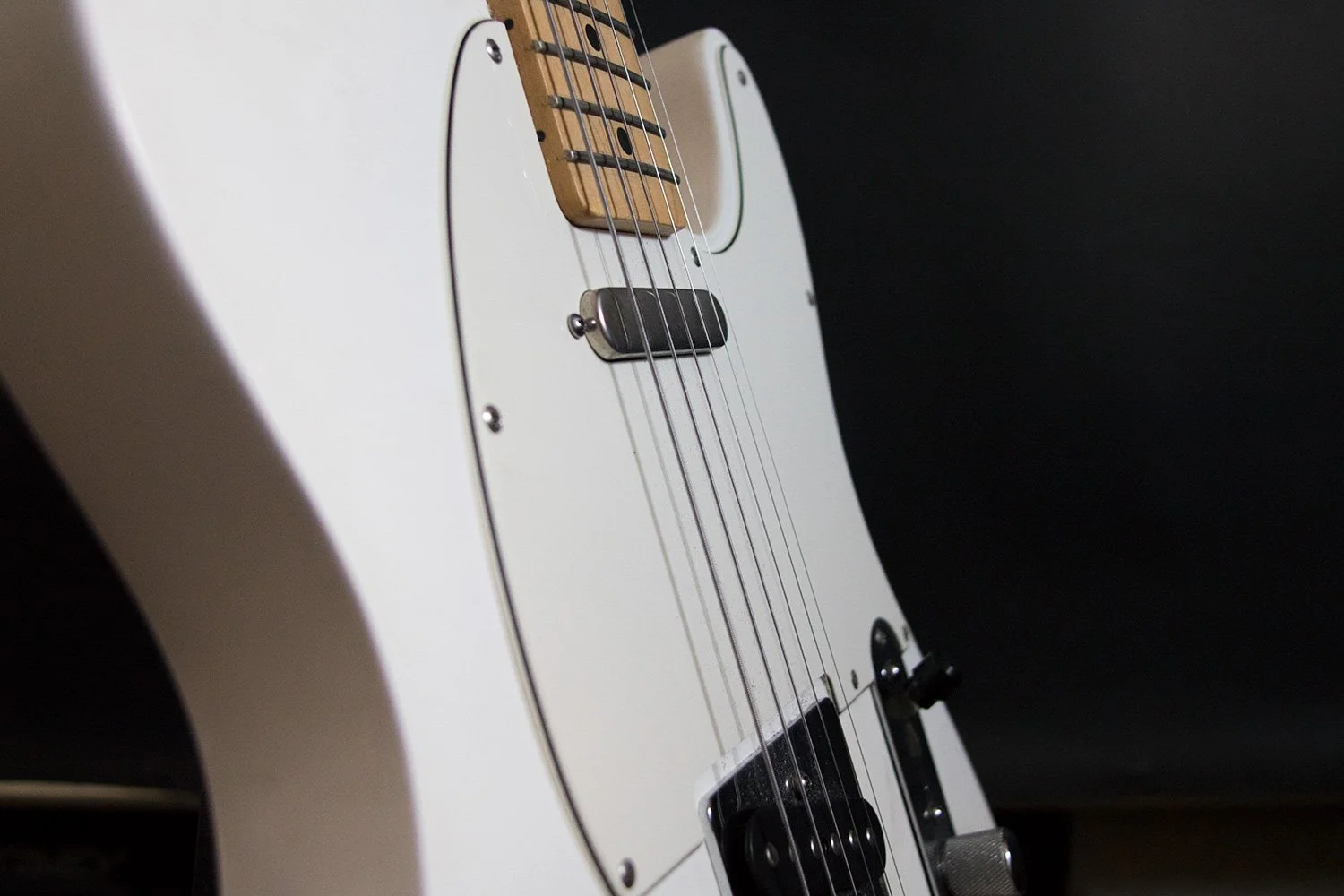
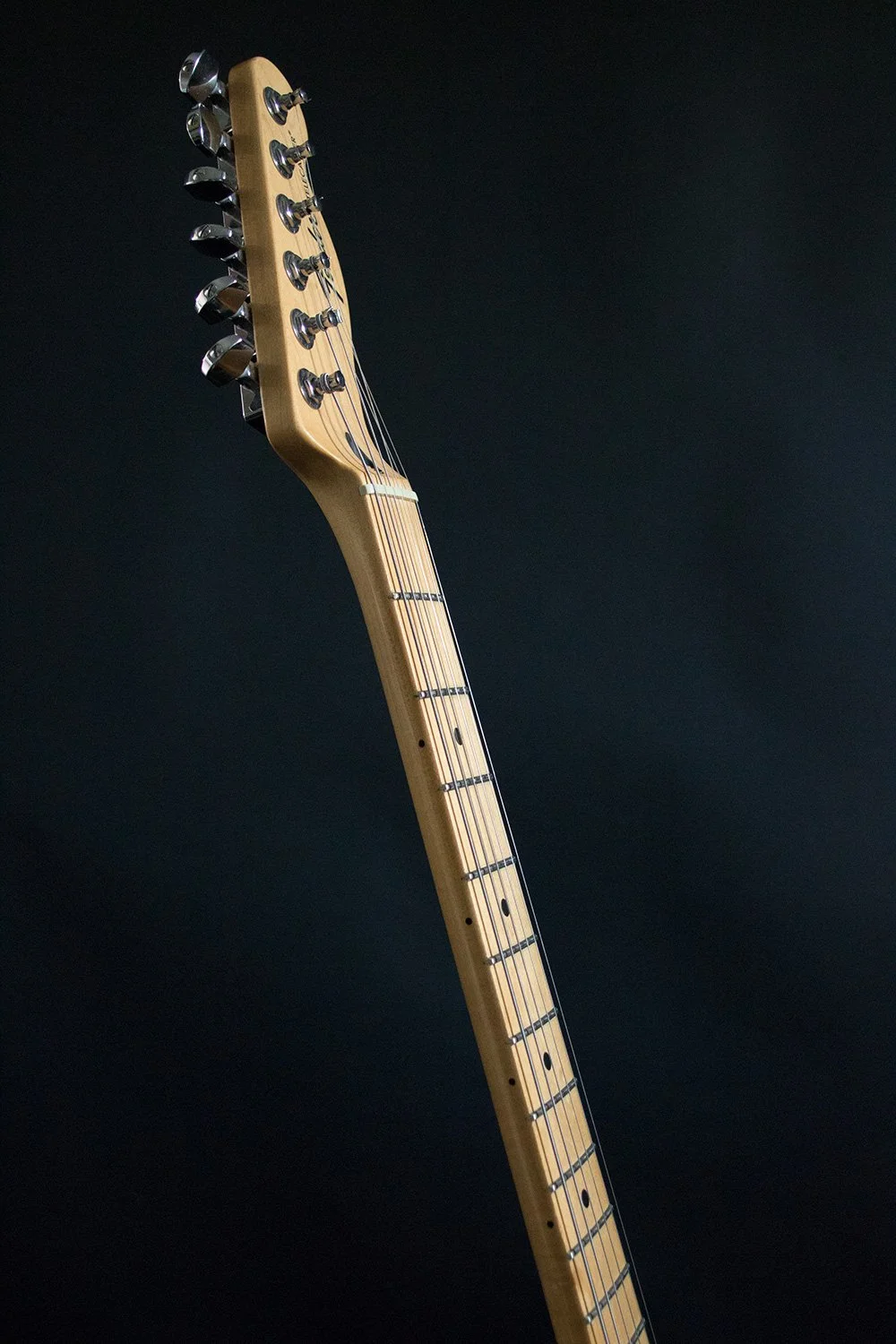
Sprightly Moans got to the point where we wanted to make a serious go of it. I thought we had great potential to actually make it in the hyper-competitive rock scene in Austin as well as the United States. I began to get our image straight. First, I got my Fender Telecaster re-done with an all white, nitro finish. It looked awesome and it sounded great:

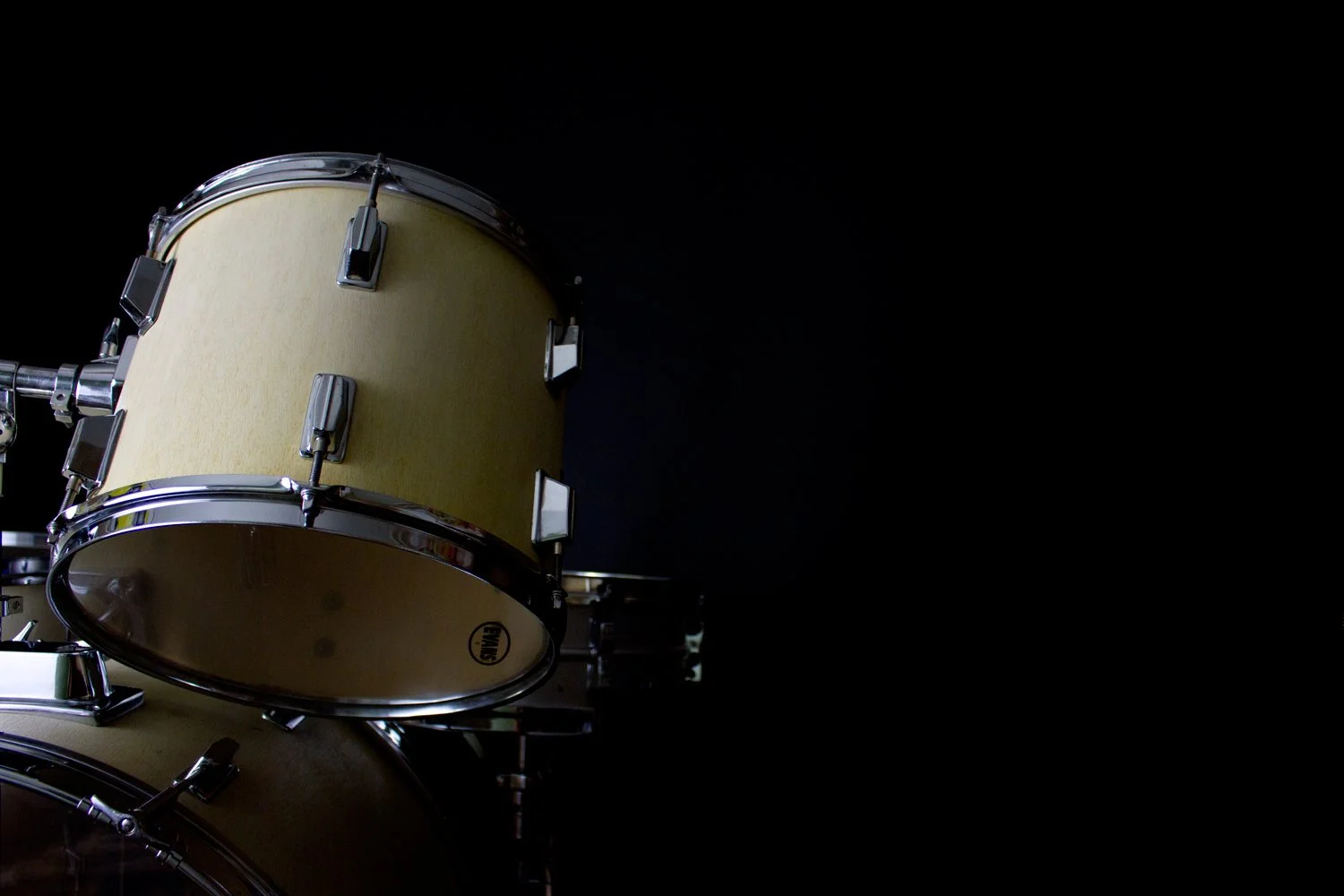
I decided to give an old drumset a monumental makeover. I stripped it of it's cover, sanded it, repainted it, recoated it, put clear drum heads on it, and all of a sudden I had this sharp-looking drumset. It helped that it sounded tremendous!

We got professional promo photos done with a great photographer, Juan Gonzalez of Lime Fly Photography:

We shot a video I'm still proud of:

And then, after all of this progress, the drummer and I parted ways. It knocked the wind right out of me. After the shock wore off, my next thought was how I was going to recoup all the money, time, effort, love, and the many hours of dreaming I put into the project. Obviously, I needed a drummer! I was already so far ahead... how hard could it be to find a drummer?

I printed posters, I posted ads, I asked friends. I auditioned five different drummers. No one really fit… One of them made fun of me, right to my face. Ouch.

Something started to feel a bit off...

Operating from a place where I wanted to recover all the resources that I put into this band ruined the fun of it. And that’s a shitty place to be at. I was trying to capture that feeling again, and it was disappearing quickly. I didn't feel right slogging it out on a project that seemed to no longer have the magic it once had. I acted out of desperation. I doggedly kept pushing forward. I still expected a return.

Eventually, after two years of nursing the dream of getting the band up and running again, I gave up the ghost on Sprightly Moans. In a deep way, I felt relieved. Sprightly Moans was no more, and I accepted that I would not be a rock and roll star after all. Sure, that hurt a little. Growing hurts sometimes. But it was healthy.

After I let it go and I properly grieved, I finally felt ready to tackle the next thing. It wasn't long after that I met Madison Bounds and started collaborating with him on his film Crisp Lips, my first film score. I had such a fun time doing it! The magic returned! I was creating music in that flow-state of musical fun.

Creative Sunk-Cost Bias

My unwillingness to let go of Sprightly Moans and my dogged persistence to reclaim the investment is a perfect example of the sunk cost bias. I was more motivated to make good on all the effort I put into that band (the mini albums, the promo photos, the music video, the time I spent making albums our of paper, and the nursing of my dreams) than I was playing the music and trusting the magic of it. I was more interested in getting a return on the money I spent on the video than I was just having fun and going with the results.

In other words, I was stuck in the past rather than finding a way to be creative.

Sunk cost bias becomes a huge hassle if we're not careful. Without knowing it, we can get pulled into a commitment and stay there even if we're totally unhappy about it. Often, I don't think we're even aware of this bias! And if we are blind to sunk-cost bias, we are similarly blind to newer opportunities, less aware of present realities, and unflexible to take advantage of a good cultural moment.

I know now that if I had given up on Sprightly Moans within a half a year (not the two years it actually took) that I would have had a massive head start on composing music for film.

Determining Sunk-Cost Bias

What can we do to guard ourselves from sunk cost bias? If you suspect it in one of your creative prospects or business doings, or if you're just plain curious, ask these questions of yourself:

  1. How worthy is this person/path/option of my commitment? Time? Energy? Money? Other resources altogether?

  2. Is there a better-sized commitment for this that's more appropriate and respectful of my resources? Time? Energy?

  3. Have I become blind to how shitty it really feels being committed to this?

  4. Do I feel a sense of being locked into this commitment?

  5. Is there an exit strategy with this commitment?

  6. If I weren't already invested in this commitment, how much would I invest right now?

  7. If I didn't already have this commitment in my life right now, how much would I work my ass off to get it? How much would I pay for it?

  8. What opportunities are getting lost as a result of me commiting to this?

  9. What else can I do with my time if I pulled the plug on this commitment?

  10. What else can I do with my money if I pulled the plug on this commitment?

  11. What else could I do with my energy if I pulled the plug on this commitment?

  12. Would I be more effective in reaching my ultimate goals if I pulled the plug?

  13. Are past investments in this option getting heavily weighted over future rewards?

  14. Are there any patterns with this commitment that are similar where past costs were prioritized over potential future gains?

  15. Call up a friend who will tell you the truth, no matter what. Explain the situation. Ask this person: "Am I prioritizing the previous investments more than I am prioritizing what I could get from it?"

  16. Are there any strong emotional reactions when I consider uncommiting to this? Name them if so. The more there are, the more likely sunk cost bias is in play.

  17. Is it time to implement a "kill criteria"? Meaning, a criteria for discontinuing projects that are not meeting expectations, regardless of past investments.

We don’t need to suffer to create art. Seriously.

I think suffering from sunk-cost bias totally roots us in the past in an unhealthy way. It doesn't feel good being tied to a creative commitment that doesn't quite do it for us anymore. In my case, it felt awful trying so hard to revive Sprightly Moans. I hoped to make that my main breadwinner. I was a little too obsessed with making my money back, with making it in the rock scene altogether. The fun disappeared.

Once I finally let it go, I felt tremendously good about what we did. Looking back made me smile, and blush a little bit too. I began to enjoy those things I invested in as loving artifacts of that period of my life. The drum set, the Telecaster, the photos, the albums, and the video.

As I mentioned before, hindsight is 20/20. Better to look back soberly at these older projects and reinterpret them as these awesome things we did. Better to marvel at the things we accomplished while we were truly in the moment, and then find a new thing that suits us even better, now.


This post was inspired and influenced by Essentialism by Greg McKeown. I totally recommend it.

Only A Few Things Really Matter

Reading Notes

3-5 Minute Read | Laptop or Tablet Recommended

Topics and Themes

Netflix's pivot to streaming; Most options are trashy; Find the best option and throw the rest out.

Reed Hastings, former head of Netflix, is living proof that only a few things really matter. The story of how Hastings built Netflix into a behemoth is partly a story of how he had numerous options presented to him, but ended up selecting the best possible path for the company. Everyone who loves to create art or music can gain valuable insights from understanding how Netflix became a household name.

How Netflix Crushed It

In the early 2000s, Netflix pretty much obliterated the movie rental market with its strategy to send DVD rentals to customers while waiving late fees. It probably put Blockbuster out of business.

Netflix was prospering. There was no reason to rock the boat. Reed Hastings, however, recognized the potential of the internet to wipe out the business model of renting physical DVDs when people wanted to watch movies at home.

He had a choice. He could maintain the existing business model based on DVD rentals, despite the drawbacks of sending physical items to customers who might not return them. Or, he could gradually leverage the expanding technology of the internet to deliver movies directly to people’s homes, instantly, with no extra effort required to return the DVD.

In other words, he could have chosen the many options that would bolster, defend, and protect Netflix's already successful DVD rental business, or he could slowly invest in a single option that had the potential to rewrite the script on how customers watched movies at home.

We all know the end to this story. Netflix is, well, Netflix. And there’s much we can learn from it as artists by analyzing it. To me, Netflix's pivot serves as an ideal example of how to filter through the thousands of bad options to get to the one option that truly crushes it.

Most Options Are Trashy

Options appear and disappear, freely, easily, and constantly. There’s no shortage of options! And to be super clear: Most of the options we have to choose from are not worth it. Very few of them have any significance at all.

Think of all the social media posts you scrolled through recently (ahem!). Which ones stand out in your mind? How many of them do you remember? I'd be surprised if you remember more than one or two posts (ahem, again!).

You had options. There's no shortage of social media posts. But if you can’t remember much about most of them, were they good options to invest your time in? Maybe doom-scrolling doesn't actually do a whole lot for us after all...

And that’s the thing: Most options are not worthy of your time.

Finding the Best Option Takes Time, Effort, and Courage

Reed Hastings invested time to uncover the internet’s potential for streaming. He invested resources into analytics and monitored the changing landscape of consumer behavior. He observed how technology improved enough to handle streaming. He moved forward because he saw the best possible route to grow Netflix. That kind of decision-making requires time, effort, and a boatload of courage.

But, just because making choices requires so much effort does not excuse us from taking every single option presented to us at face value. Let's not make a friend out of laziness.

As we create, be it music or art or film or whatever, we will encounter thousands of options. They will get delivered to us, constantly, whether we like it or not. Should we use this color? Should we use that chord progression? Should we shape the character’s arc in more ways?

Choosing gets easier when we remember that most of the options don't have any value. Only a few options truly matter. John Maxwell rightfully said: You can not overestimate the unimportance of practically everything.

Perhaps we, as artists, ought to save ourselves for the one extraordinary option that outshines all the others and lean into it. Perhaps we could do better to accept the tradeoffs of cutting away the insignificant in favor of the one brilliant and shining idea.

Reed Hastings certainly had plenty of insignificant options in front of him. He could have bolstered and propped up Netflix’s DVD rental business with all his resources. And yet? He chose the best option after quite a lot of deliberation and gradually invested in it. He made that decision thoughtfully, and now we all know Netflix.

In our work as creatives, let’s do the same. Let’s carefully discard as many trivial (or trashy or insignificant or stupid) options as possible. Let’s instead invest in the best options only, from here on out.

Let's do the art that we really want to do.


This post was inspired and influenced by Essentialism by Greg McKeown. I totally recommend it.

How The Artists Way Turned A Film Producer Into A Recipe Explorer

Reading Notes

7-9 Minute Read | Laptop or Tablet Recommended

Topics and Themes

The Artist's Way by Julia Cameron; A journey of a hard-working film producer exploring her creativity; The transformation we can expect from getting in touch with our creativity.

In 9th grade, I permanently borrowed The Artist's Way from my Mom. The title arrested my attention... I had no idea why, but I just needed to liberate it from her bookshelf and keep it for my very own. Sorry, Mom! Only later did I realize how pivotal that act would be for my personal and professional life.

If it weren’t for The Artist's Way, I probably wouldn’t have become a professional musician. It is widely regarded as one of the most influential books on the topic of creativity. In it, author Julia Cameron invites readers to roll up their sleeves and get to work opening the channel to greater creativity. The book does not wax poetic about the wonders of creativity or how the master artists were so creative. Instead it teaches readers how to dig in and become creative themselves through a 12-week program of self-exploration.

The Artist's Way ignited my creativity by teaching me that journaling, often referred to as the morning pages, helps unlock a creative mindset. At first, I struggled getting up before other members of my family, but I got used to it eventually. I began in earnest to write my morning pages. I began to enjoy the feel of the pen in my hand. I needed a place to vent my teenage frustrations anyways... a dual bonus!

I continued writing my morning pages (and going on artist dates) for many years. I still find time for both of them in my busy life, today. I find them indispensible for my creative process. Regardless of whether I'm working on a film score or an album, the common denominator has always been the daily task of the morning pages. They have nourished me for 30 years.

So, when my good friend Mary Beth Minnis asked me if I had ever read The Artist's Way, I couldn’t contain my excitement.

Mary Beth Minnis is an American movie producer known for her work in documentary films. She most recently collaborated on the projects Refuge, Juneteenth: Faith And Freedom, and Jump Shot, each of which addressed lesser-known stories that needed to be told. All of the films are worth watching. She’s currently working with directors Laura Waters Hinson and Claudia Myers on the film The Test, a film about a maintenance man at a Virginia retirement center who dreams of becoming a citizen so he can reunite with his wife and children in Ghana. With his future at stake, he enlists the help of two elderly residents to prepare for the biggest test of his life: the US Citizenship exam. I saw The Test at Austin Film Festival in 2023. It was the only movie from that year that made me cry. I highly recommend it.

Mary Beth’s career as a producer is highly competitive and energetically intense. She once told me she dedicates an average of three years to a single film. It requires a lot of her, but she loves it.

When Mary Beth casually asked me if I had ever read The Artist's Way, I spilled my guts about my absolute love for that book and all it can do for anyone who commits to it. I was also thrilled that my friend, this high-powered, absolutely badass film producer, seemed eager to explore creativity on a deeper level. I couldn’t help but offer to be a guide and accountability partner as she went through the book.

We agreed to meet up each week to discuss the book, chapter by chapter. I’d pester her about doing the morning pages and the artist's dates, and we’d move forward to the next chapter.

At first, Mary Beth had a little trouble fitting the morning pages into her busy life. She also had a little trouble grasping why she needed to do the artist's date. To provide context, the artist's date is a scheduled hour or two full of fun. It’s about doing something interesting to our inner artist in an easy, effortless, playful way. It often feels like we are wasting time doing it. At first, she didn't see the point of doing it.

Yet, she kept on reading the book, doing the morning pages, and going on the artist's dates. She dug in! She had no idea what was going to happen. Me? I was super excited. I knew I was in for a big surprise and I couldn't wait until it revealed itself.

Gradually, moments of spontaneous creativity burst into her life. One day, a recipe for a cake unexpectedly came to her mind. She approached it with a sense of curiosity and playfulness. She explored it without pressure, without needing to complete it immediately. She gave the recipe the space to breathe and become what it wanted to be.

Let’s back up: You need to remember that Mary Beth Minnis does not slack off in her job as a film producer. It was quite a juxtaposition for her to explore a recipe so casually, in such a carefree way.

Instead of saying, “I have to get this cake done or I’m not creating,” Mary Beth allowed herself to have some fun exploring the recipe of that cake. She flowed. She adjusted how much more, or less, of each ingredient she wanted in the cake. Eventually, she found just the right balance. She put almost no efforting into the entire process.

Before she knew it, she had a cake recipe that she liked. She baked the same cake for friends at a potluck and didn’t tell anyone it was hers. The cake vanished in a few minutes. Everyone raved about it. She began to share the recipe with friends who baked it and loved it. She felt like she might be onto something!

Then, even more magic happened: New recipes flowed to her in a remarkably easy way. An ingredient she used in one recipe inspired another. The same thing happened, over and over again. She was thrilled! She was opening up and enjoying the process of creating new recipes just for the sake of creating, and they were pouring out of her imagination.

Again, I want to underscore a really important point: It's super difficult to be a film producer. Film producers are by-and-large responsible for the success (or failure) of a film. They think in hard terms of fiduciary responsibility, management, and business productivity. They corral people together to get a project done on time and under budget. Mary Beth excels at producing films. But, since her involvement was more on the practical side of filmmaking, she doubted her ability to create.

And yet, she ended up completely immersed in the process of creation. It just wasn’t in a way that she expected. Perhaps she thought that creativity was reserved for those with that innate creative gene. Still, she found herself lost in the joy of creating new recipes. I didn’t expect it either! And that’s the point. We never know what we'll create until we are open and carefree enough to try.

I can’t help but marvel at her transformation. What a joy to witness!

If Mary Beth's journey resonated with you, I humbly recommend The Artist's Way. This book will teach you how to embrace your creativity if you commit to it for the 12 weeks it asks of you.

It’s worth it for the joy, alone.

The age of character genre?

I was just musing: Is the fact that most musical territory has already been explored necessarily a bad thing?

The argument many people have with music is something like, “That’s not original. Someone else has already done that.” Well, no shit Sherlock.

Let’s take an obscure example: Coltrane practiced Slonimsky’s Thesaurus of Scales and Melodic Patterns towards the latter part of his life. He explored it deeply, and had he lived longer he could have explored it more fully. However, Coltrane applied this to his music. His group towards the later part of his life (after McCoy and Jones and Garrison) was his vehicle to bring that study into sonic format.

Now onto the thought experiment: What if a band with an established voice, like Radiohead for example, started to study the same text that Coltrane studied. Would Radiohead make free jazz? Maybe, maybe not. But undoubtably, it would sound like Radiohead. And yes, I’d buy it too.

The age where original musical ideas created on brand new theoretical ideas is pretty much gone, with exception to those lone classical voices creating music in academia. The age of original voices using the same established theoretical models is happening now.

In other words, pop and country and hip hop inspired beats mixing together to form bro country is just one iteration. All it takes is an original voice willing to explore something different to give us all something brand new, fresh, and exciting to groove on.

Originality is overrated. It’s better just to establish a voice and then take it on a musical journey from there.

Dave WirthIdeas, Creativity
Great news for creative people in their 40’s

Here’s a thought, according to the BBC, people have creative peaks in their 20’s and 50’s. This means for any creative in their 40’s, the next creative spurt is yet to come:

Professor Weinberg says that young people who feel they’ve got more to accomplish should keep going.

”Someone who is experimental and is accumulating knowledge gradually over time is someone who really, really should not give up.

”I mean we don’t necessarily know how eminent they will get and how their achievements will be.

”But for that type of person they will do their best work - at least their best innovative work - later in their careers and they should be aware of that and keep going.”
— https://www.bbc.com/news/newsbeat-48077012
The Proviso

One statement I hear from other artists is “I hope I’m not being egotistical, but...” Then, the artist tells me of what they created.

I get it. No one wants to be remembered as a narcissist. But perhaps there’s a better way to frame it.

To accomplish a kinder share of our creative output, include the following proviso:

Hey, I created this [work of art, music, etc] and thought to share it with you. I don’t want you to write me back and tell me how much you like it, especially if you don’t. I require no praise, and besides, I’m so slammed that I won’t remember sending this to you in the first place! I’m only sharing it to make your day a little brighter. That’s all. Take good care!

Dave WirthCreativity
The death of idea generating places?

Here’s a quote from Alan Fletcher’s book “The Art of Looking Sideways”: 

 Ivan Chermayeff does much of his thinking in taxies, Lon Dorfsman on planes, Steve Guarnaccia on the subway. Designers also talk of getting ideas when they are on the sleep borderland...”

Challenge: Can you successfully not pick up your smart phone in a taxi, on a plane, on the subway, or in that sweet transition from sleep to wakefulness? Can you do this in the service of idea generation?